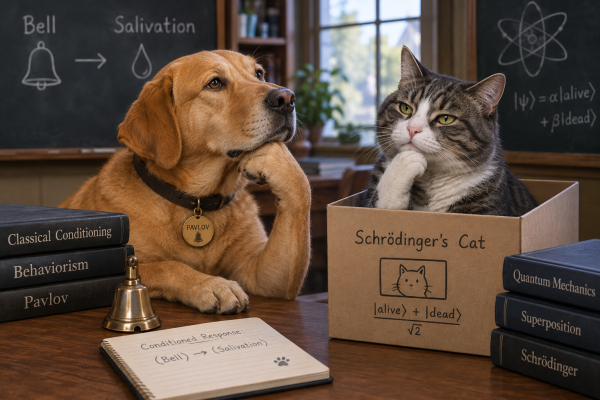
Pavlov’s Dog and Schrödinger’s Cat
Pavlov’s dog and Schrödinger’s cat never actually met, as far as history records. But if they had, I suspect they would have got on immediately.
They were both victims of science. Both had been dragged into experiments by humans who seemed endlessly fascinated by what happened inside an animal’s head. And both, I imagine, eventually reached the same conclusion: Humans are exhausting – as well as tedious.
Pavlov’s dog had it particularly hard. Every day, Ivan Pavlov would appear with his clipboard, his serious expression and that ridiculous bell.
Ding.
The dog would look up.
Pavlov would smile.
Ding.
The dog would look up again.
Food was involved, of course. But perhaps, after a while, the dog wasn’t salivating because he expected dinner. Perhaps he was doing it because he knew Pavlov wanted him to.
‘Very good,’ Pavlov would say, scribbling furiously.
The dog would think: That’s what you think, Ivan.
The dog had figured out something that Pavlov hadn’t: sometimes we don’t respond because we have to. We respond because we know someone wants us to. The bell became less about food and more about keeping Ivan happy. Eventually, Pavlov would ring it, and the dog would sigh.
There. I’m salivating. Are you satisfied now?
Meanwhile, somewhere in the theoretical universe, Schrödinger’s cat was having an even worse day. The poor little pussy had been placed in a box and was now apparently both alive and dead, depending on whether anyone had bothered to look. Pussy was not impressed.
‘Honestly,’ it must have thought, ‘I spend my entire life trying to get humans to leave me alone, and now they’ve put me in a box and invented a philosophical crisis around me.’
The dog and cat would have had plenty to discuss.
‘So,’ the dog says, ‘they ring a bell and watch me.’
‘They put me in a box and watch whether I exist,’ the cat replies.
‘Humans are weird.’
‘That’s the least of it, mate.’
At least the dog had company. The cat had quantum mechanics.
And perhaps the two animals would have discovered that their experiments weren’t really about them, they were about themselves, humans. Pavlov wanted certainty: ring the bell, get the response, write it down. Schrödinger wanted us to question certainty itself: until we look, perhaps reality refuses to settle into something as simple as alive or dead. The dog would probably find this amusing.
‘You know,’ he says, ‘I’ve been answering that bell for years, and Ivan still thinks he’s studying me.’
The cat flicks its tail and yawns.
‘I’ve been studying humans for years and they are idiots. They feed us, give us a home and pick up our poo. Would you do that for Ivan?
‘Not on your life.’
And perhaps that is the funniest thing about both experiments. Pavlov’s dog wasn’t simply a dog drooling at a bell. He was a creature learning the strange rituals of another species. Schrödinger’s cat wasn’t really about a cat being alive or dead. It was about humans discovering that the universe doesn’t always behave as neatly as they would like it to. The dog learned to please Ivan. The cat learned to distrust boxes. And humanity learned that perhaps the animals had been watching us all along.
If the dog and cat could meet today, I suspect they’d sit quietly in a corner, exchange a knowing glance, and agree on one thing: Never trust a scientist carrying a clipboard. And if someone rang a bell? The dog would probably ignore it. After all, Ivan wasn’t there anymore.
And finally, perhaps, the dog was free to do exactly what he wanted. The cat, secretly, always had.